Definition
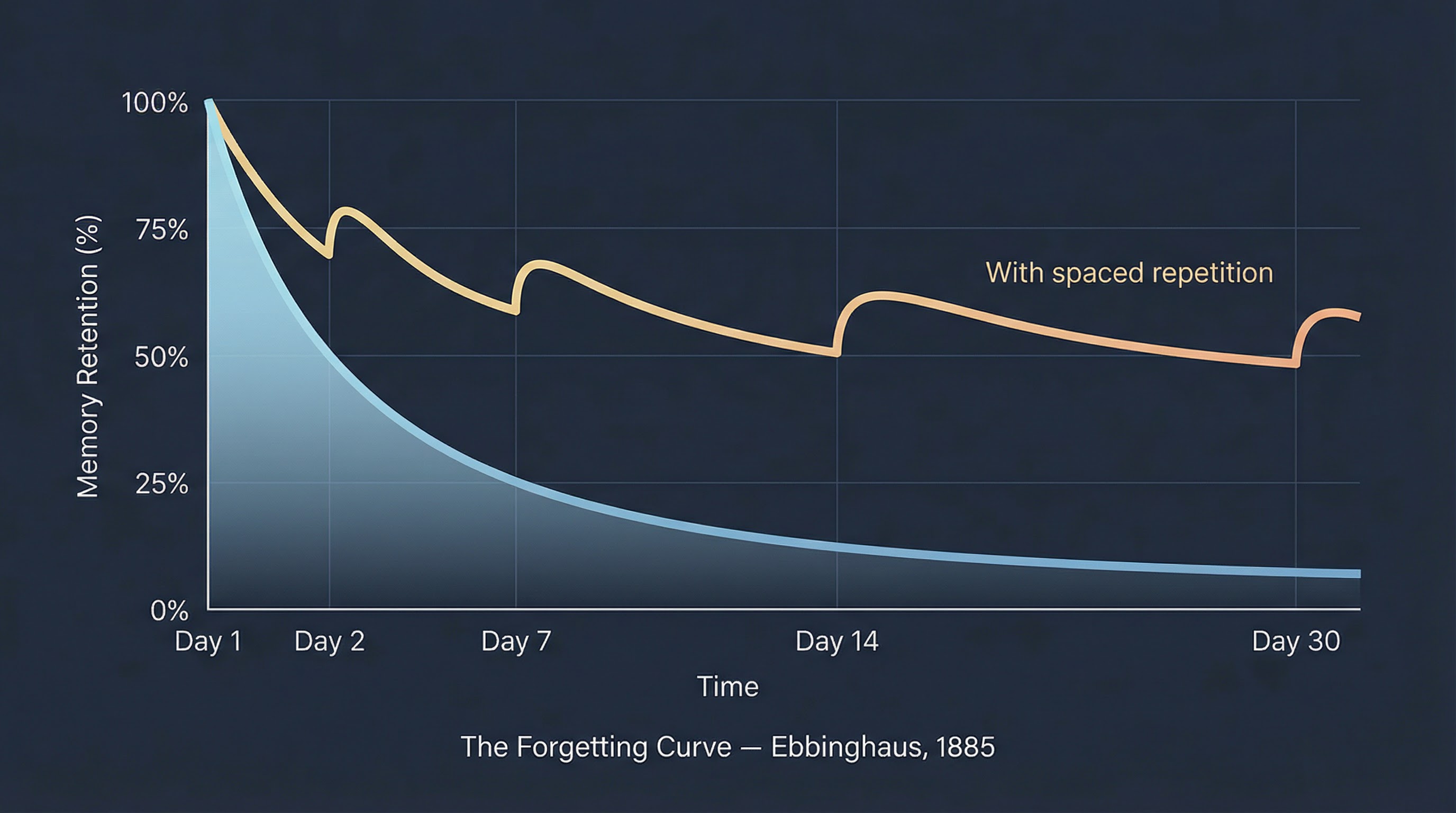
The Ebbinghaus forgetting curve is a graph of memory retention over time without reinforcement. It shows that the brain forgets approximately 50% of new information within one hour, 70% within 24 hours, and up to 90% within one week — before the rate of decay begins to slow.
1885
Year of discovery by Hermann Ebbinghaus
50%
Forgotten within 1 hour without reinforcement
70%
Forgotten within 24 hours without reinforcement
90%
Forgotten within one week without reinforcement
Hermann Ebbinghaus: the researcher
Hermann Ebbinghaus (1850–1909) was a German psychologist who brought experimental rigour to the study of human memory at a time when psychology was still largely philosophical. Working at the University of Berlin, he used himself as his only test subject — memorising lists of meaningless two-letter syllables (ba, lek, zup, and thousands of others) and then measuring how much he retained at precise intervals.
The work was published in 1885 as Über das Gedächtnis (On Memory). It introduced the concept of the savings method: rather than asking how much was remembered, Ebbinghaus measured how much less effort it took to re-learn the material after a delay — a more sensitive measure of retention. The result was a clean exponential decay curve, reproducible across thousands of trials.
What the curve shows
The forgetting curve describes the rate at which memory retention falls over time without any review or active engagement. The key features:
- Fastest at the start: The steepest drop occurs in the first hour after learning. This is when review is most valuable — and most neglected.
- Exponential, not linear: Forgetting is not steady. It front-loads: most of what will be lost is lost quickly, after which the rate slows considerably.
- Asymptotic: The curve approaches but never quite reaches zero. Some very small residue of exposure persists indefinitely — a tiny advantage in relearning even decades later.
- Affected by meaningfulness: Ebbinghaus used nonsense syllables deliberately to isolate the pure memory process. Real-world material — which carries meaning, emotional weight, and prior associations — decays somewhat more slowly, but the curve's general shape holds.
How to fight the forgetting curve
Ebbinghaus did not only document the problem — he identified the solution. He found that reviewing material at spaced intervals before it was forgotten could dramatically slow the curve and eventually stabilise retention at a high level. This was the first empirical evidence for what is now called spaced repetition.
Spaced repetition
Reviewing material at increasing intervals — the direct solution Ebbinghaus proposed. Each review resets the curve.
Active retrieval
Testing yourself from memory rather than re-reading. Forces the brain to reconstruct the memory, which strengthens the trace.
Elaborative encoding
Connecting new information to what you already know. Meaningful material decays more slowly than isolated facts.
Sleep consolidation
Memory consolidation occurs during sleep. Adequate sleep after learning measurably slows forgetting.
Highlighting and note-taking
Capturing key moments creates retrieval cues and forces a moment of active evaluation during exposure.
The curve and modern content consumption
Ebbinghaus ran his experiments on controlled, meaningless material. The implications for real-world content consumption — podcasts, articles, videos, lectures — are arguably more significant. We consume extraordinary volumes of content daily, almost all of it passively, almost none of it reviewed.
The forgetting curve applies regardless of how good the content was. The podcast episode that changed how you think about sleep, or productivity, or relationships — the one you described to a friend that week — has followed the same exponential decay. Without review, what you retain after a month is roughly what Ebbinghaus measured: close to nothing.
This is not a personal failure. It is physiology. The brain was not designed to retain everything it encounters. It was designed to retain what it encounters repeatedly, in varied contexts, with time in between.
Read more: Why your brain forgets almost everything — and what the science says to do about it
Related
Fight the forgetting curve in your podcast listening
Luna is built on the neuroscience of memory. Highlight, review, and retain.